Every fleet operator tracks MOT dates. The question is how — and whether your current method will still work when something slips through the cracks at the worst possible time.
For fleets of two or three vehicles, a simple spreadsheet or a few calendar reminders is perfectly fine. You can check gov.uk once a month, update your dates, and move on. But as your fleet grows, the gap between "it works" and "it's reliable" gets wider — and the consequences of getting it wrong get more expensive.
This article looks at when a spreadsheet is enough, when it isn't, and what to look for if you decide it's time for something better.
The spreadsheet approach
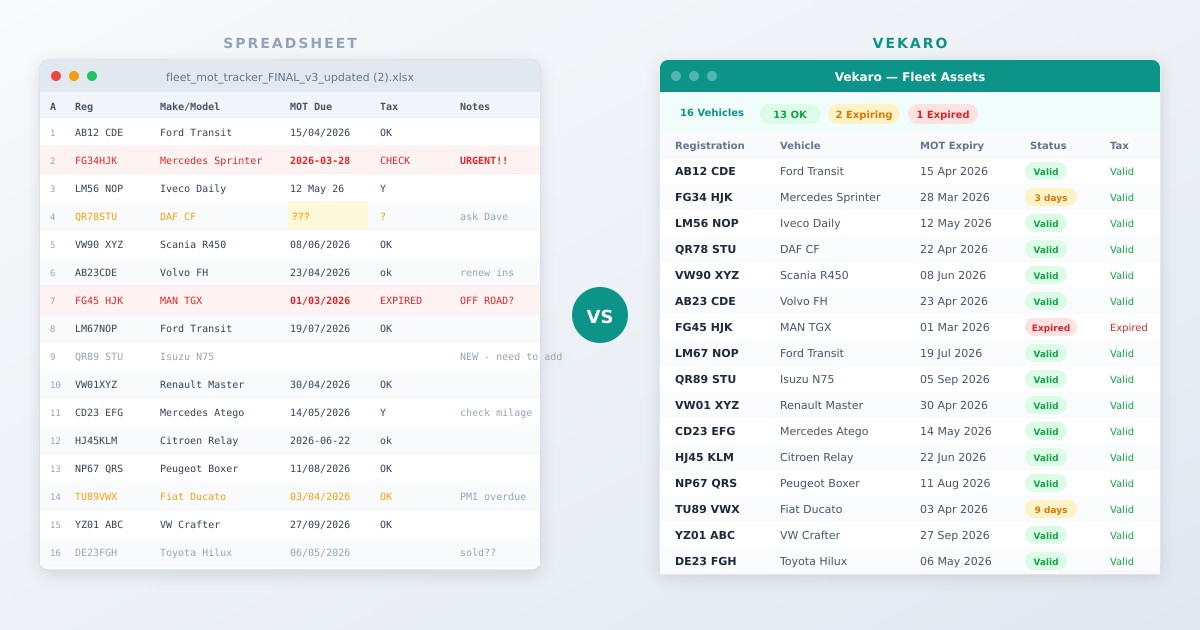
Most fleet operators start with a spreadsheet. It's free, familiar, and flexible. A typical fleet MOT tracker looks something like this: a column for registration, one for make and model, one for MOT expiry date, maybe a column for tax and one for the last service date.
For a small fleet, this works. You open the spreadsheet once a week, scan the dates, and book any tests that are coming due. The total time investment is ten minutes a week, and the cost is zero.
But the spreadsheet approach has some fundamental limitations that become more serious as your fleet grows.
Where spreadsheets start to fail
The first problem is that spreadsheets don't update themselves. When a vehicle passes its MOT, someone has to manually check the new expiry date on gov.uk and type it into the spreadsheet. If that person is off sick, on holiday, or just busy, the spreadsheet goes stale. You're making decisions based on data that might be weeks old.
The second problem is accountability. A spreadsheet doesn't tell you who updated it last, whether the dates have been verified recently, or whether anyone has actually checked the vehicles that are coming due. There's no audit trail. If a DVSA examiner asks to see your compliance system and you show them a spreadsheet, they'll ask how you verify the data is current. "Someone checks it" isn't a robust answer.
The third problem is scale. At five vehicles, checking each MOT date takes a few minutes. At fifty vehicles, it takes half a morning — and the chance of missing something is much higher. At a hundred vehicles, manual tracking becomes genuinely risky. One missed expiry means a vehicle on the road without a valid MOT, which means an immediate prohibition if stopped, a fine of up to £1,000, and a negative impact on your OCRS score that could affect your O-Licence.
The fourth problem is that spreadsheets only track what you put in them. They don't know that a vehicle failed its MOT yesterday, or that the DVSA issued an advisory about brake wear at the last annual test. They can't alert you when something changes. They're a snapshot, not a live picture.
When does a spreadsheet stop being enough?
There's no magic number, but most operators find that spreadsheets start to creak at around 15 to 20 vehicles. That's the point where manual checking takes enough time to feel like a chore, where the risk of missing something becomes real rather than theoretical, and where the cost of getting it wrong starts to outweigh the cost of a proper system.
If any of the following apply to your fleet, a spreadsheet is probably costing you more than you think:
You have more than 15 vehicles and tracking dates takes more than 30 minutes a week. You've had a near-miss where a vehicle was nearly sent out with an expired MOT or tax. You run HGVs or PSVs where the annual test is managed by the DVSA rather than the DVLA, and tracking test dates means checking a different system. Multiple people in your organisation need access to compliance data but you're relying on a shared file that's easy to overwrite or lose. You need to provide evidence of a compliance system for your O-Licence, FORS accreditation, or a customer audit. You're spending time manually checking gov.uk for each vehicle when that data could be pulled automatically.
What fleet compliance software actually does
Fleet compliance software replaces the manual process of checking, recording, and monitoring vehicle compliance data. Instead of you going to gov.uk to check each vehicle, the software connects to government APIs and pulls the data directly.
Good fleet software should do the following as a minimum:
Pull MOT and tax status automatically from the DVLA so you never have to check manually. For HGVs, pull the annual test history from the DVSA including test results, advisories, and mileage readings. Show you a dashboard with your fleet's compliance rate at a glance — how many vehicles are compliant, how many are expiring soon, and how many need attention. Send you alerts before an MOT or tax expiry so you have time to act. Let you store documents like V5Cs, insurance certificates, and inspection reports against each vehicle so everything is in one place. Track service schedules so PMIs, annual services, and inspections are managed alongside MOT and tax dates.
What about the cost?
The traditional fleet software market charges per vehicle per month — typically between £3 and £8 per vehicle depending on the platform and features. For a 50-vehicle fleet, that's £150 to £400 per month, often on a 36-month contract. That's a significant commitment before you've even seen whether the software suits your operation.
Newer platforms are moving towards flat tier pricing, where you pay a fixed monthly amount based on your fleet size band rather than a per-vehicle charge. This means the cost is predictable and doesn't jump every time you add a vehicle. A flat tier for up to 75 vehicles might cost £79 per month regardless of whether you have 20 or 70 vehicles on the system.
The real cost comparison isn't software versus spreadsheet — it's the cost of the software versus the cost of getting it wrong. One prohibited vehicle costs more in fines, downtime, and OCRS impact than a year of fleet software.
What to look for when choosing fleet software
If you decide to move from a spreadsheet to software, here's what matters:
Self-service signup with a free trial. You should be able to try the software with your real vehicles before committing. If a provider requires a demo call and a 30-minute sales pitch before you can even see the product, that tells you something about how they value your time.
No long-term contracts. Your needs might change. A 36-month contract is a big commitment for software you haven't used in anger yet. Look for monthly billing with the option to cancel anytime.
DVLA and DVSA integration. The software should pull vehicle data automatically — not require you to type it in manually. If you're entering the same data you'd put in a spreadsheet, you've just moved the spreadsheet into a browser.
Transparent pricing. You should be able to see the pricing on the website without requesting a quote. If the price isn't published, it's usually higher than you'd expect.
UK-focused. A platform built for UK operators will use the right terminology, connect to the right government APIs, and understand the compliance landscape. A global platform adapted for the UK market often misses the nuances.
The honest answer
If you have five vehicles and you're disciplined about checking dates, a spreadsheet is fine. Don't pay for software you don't need.
If you have 15 or more vehicles, run HGVs or O-Licence vehicles, need to track services and documents alongside MOT and tax, or have multiple people who need access to compliance data — a proper system will save you time, reduce risk, and pay for itself the first time it catches something you would have missed.
The best approach is to try both. Keep your spreadsheet running alongside a free trial of fleet software for two weeks. See which one gives you more confidence that your fleet is compliant. The answer usually becomes obvious within a few days.
Try Vekaro free
Vekaro connects to the DVLA and DVSA to track MOT, tax, services, and documents for your entire fleet — automatically. No spreadsheets, no manual checking, no long contracts.
Start a free 14-day trial at vekaro.co.uk and see the difference for yourself.
Ready to ditch the spreadsheet?
Try Vekaro free for 14 days. No credit card required.
Start Free Trial